DISC 46 /ARTICLE 26:
Perfect Love
Perfect love is that renewal of our fallen nature by the Holy Spirit, received through faith in Jesus Christ, whose blood of atonement cleanseth from all sin; whereby we are not only delivered from the guilt of sin, but are washed from its pollution, saved from its power, and are enabled, through grace, to love God with all our hearts and to walk in His holy commandments blameless.
* * *
The EMC added this Article to Wesley’s original 25 to ensure this essential doctrine of holiness was preserved in accordance with Wesley’s emphasis and teaching. As such, it is found in the Discipline, at the end of the Articles. However, since our purpose here is to show the continuity of our Articles, we decided to cover it following Article 9 on justification, with its joint emphasis on initial sanctification.
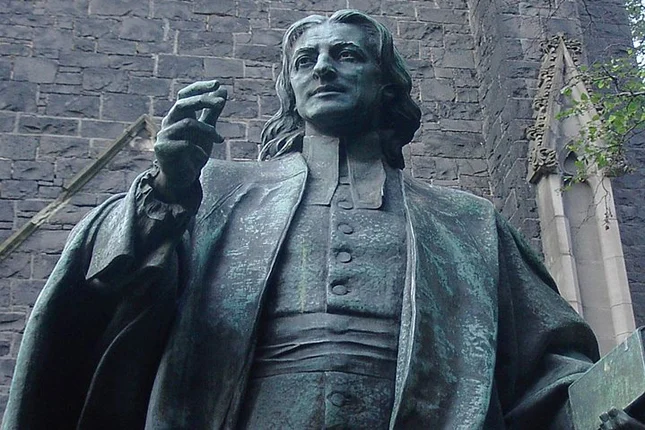
In John Wesley’s day, he taught that every Christian should yearn to be entirely sanctified from sin and fully devoted to God, through the unhindered presence of the Holy Spirit in our lives, as we surrender completely to Him. Wesley called this state of holiness and righteousness “Christian Perfection”. He taught that it was obtainable in this life by faith, both gradually and instantaneously.
As time has passed and language has evolved, the term “Christian perfection” has often been misunderstood. In Wesley’s usage, it was never meant to imply perfect performance; in fact, the whole idea of performing stands in stark contrast to Wesley’s teaching. Instead, the intent was to convey that God calls us to love Him and others, perfectly and completely, with our whole heart, soul, mind, and strength. It is also important to note that while Wesley taught that this state of perfect love was attainable in this life, he did not believe that this grace would automatically deliver Christians from temptation, infirmities, ignorance, or mistakes, because these are the shared experiences of all people so long as they live in this life.
The EMC accepts Wesley’s Sermons, Wesley’s Notes on the New Testament, Wesley’s Journal, and Wesley’s A Plain Account of Christian Perfection as the best doctrinal interpretation.
* * *
Reflect on the following Biblical texts. What are your thoughts on the way they reveal this doctrine to us? Discuss your answers with your pastor/group leader.
Isaiah 1:1-31 / Isaiah 58:1-14
Matthew 22:34-40 (cf. Deuteronomy 6:1-25)
Luke 10:25-37 (cf. Matthew 5:43-48)
John 15:1-12 / John 17:1-26
Romans 8:1-39
2 Corinthians 5:1-21
Galatians 5:13-26
Colossians 3:1-17
Hebrews 10:1-39
James 1:19-27
1 Peter 1:13-25 / 1 Peter 2:1-10
1 John 2:1-11
* * *
Use the following questions to summarize what you have learned about this Article of Faith. Discuss your answers with your pastor/group leader.
How is love perfected in us by faith?
What kind of fruit is produced in our lives when love is perfected in us by faith?
How does love, being perfected by faith, help us fulfill our purpose of being God’s image and covenant partners?
Historically, this doctrine was often referred to as “Entire Sanctification” or “Christian Perfection”. How does “Perfect Love” help to express this biblical teaching more clearly?
How does this doctrine affect the practice of our faith?
Notes:
LEVEL ONE ACCESS POINTS FOR FURTHER ENGAGEMENT

LEVEL 1: ARTICLE 2
LEVEL 1: ARTICLE 4
LEVEL 1: ARTICLE 7
LEVEL 1: ARTICLE 8
LEVEL 1: ARTICLE 9
LEVEL 1: ARTICLE 10
LEVEL 1: ARTICLE 11